
Envisioning Inclusion
This fall semester, Professor Cheryl Giles joined a number of members of the HDS community in calling for a more conscious religious engagement with injustice.
At an October panel discussion, “Changing the World from the Inside Out: Multi-Faith Perspectives on the Inner Life and Social Justice,” Giles said issues of racial and social justice have taken on even more urgency in the wake of a contentious presidential election. As a result, students, faculty, and staff are trying to reimagine a new era in the fight for justice.
“We are simply missing the point if we merely sit on our cushions and do not engage in the world,” Giles explained. “There is no liberation or path to freedom until we acknowledge injustice, understand the suffering of the oppressed, and commit to fight against all oppression. We can talk about injustice as if it is a thing beyond our reach, but if we get serious we can start by beginning to care for each other and our deepest humanity.”
In addition to the work being done—and that still needs to be done—around areas of social and racial justice, during the School’s bicentennial year, it is important to reflect on how the HDS community’s 200 years of service and leadership has contributed to the social and racial justice movements of the day.
History
This year, Ann Braude, director of the Women's Studies in Religion Program, curated the “Faces of Divinity” exhibition, which established a visual mapping throughout the HDS campus of the long history of moral leadership HDS has fostered. While there is a plethora of examples of social and racial justice over the past 200 years, the exhibition demonstrates the community’s continual commitment to identifying inequalities, dissecting their origins and persistence, reflecting on its own shortcomings, and serving the community with the intent of creating a more just world.
Beginning in the early nineteenth century, Divinity School students and faculty committed to make anti-slavery integral to their ministry. Students like James Freeman Clarke (HDS 1833) “thrust the issue of slavery into the center of his ministry and activism.”
Professor Henry Ware Jr., a leader in the Unitarian Universalist community at Harvard, created and later served as president of the Cambridge Anti-Slavery Society.
Deans Francis Greenwood Peabody, in the early-twentieth century, and Krister Stendahl, in the mid-twentieth century, understood HDS to be a key element of the University’s outreach and moral leadership.
In the 1960s, members of the HDS community played prominent roles in the Civil Rights, women’s, anti-war, and environmental movements. Legendary professor Harvey Cox has seen the School develop as a hub for justice initiatives over the last 50 years. Cox recalled the Harvard anti-Vietnam war movement and the central role that the HDS student community played at the time.
“The main student involvement in my early years was opposition to the Vietnam War and the student strike 1969 in Harvard Yard. Actually, all through Harvard there was a strike, occupations of buildings—including the administration building—and HDS students were very involved in that.”
Today
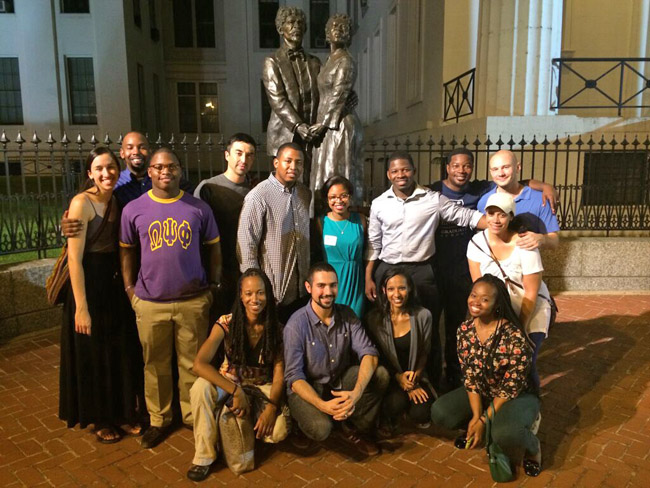
That same spirit of social justice and moral leadership lives on today. The Harvard University Dining Services strike that became national news was an important cause for many HDS students and faculty. MDiv candidates Nestor Pimienta and Gaby Chavez, vocal and visible leaders around campus, mentioned the work done by many of their colleagues in support of this new fight for labor justice.
“Members of our Student-Led Interfaith Coalition (SLIC), which was formed during the interfaith service, went to the lines to listen to workers talk about everything from their families, to their worries, to their fear,” said Pimienta. “We used stoles that were made by fellow student, Francesca Cipriani, to signal to the workers that we were here for them. We felt that it was important to simply be a presence for the workers during this time in their lives and be with them on their journey—not just physically, but spiritually. We cried and laughed with them. We felt it was important to be with the workers and stand by their sides, regardless out the outcome.”
While movements for justice have remained the modus operandi for many members of the HDS community, what justice looks like on the HDS campus continues to be critiqued and discussed. In recounting the absence of black scholars and faculty decades ago, Cox notes that HDS was a completely white male space for much of his early days.
“There was a growing feeling among the faculty and students that we were not doing very much on that side,” Cox said. “We didn’t have very many black students, and we had no black faculty at all.”
As these sentiments gained traction amongst the community, the HDS Student Association (HDSSA) began creating spaces in which scholars of diverse backgrounds could enter and permanently shift the culture of the School.
The HDSSA created the Committee on Race Relations and formed what would be coined as the “Black Audit.” The audit brought black scholars like esteemed Harvard professor Preston Williams (who later served as the first director of Harvard’s Du Bois Institute as well as acting dean of the Divinity School) to critique what they called the “implicit racism” of HDS’s curriculum and discourse, and its inability to properly address the concerns and interests of black students as a whole. This internal critique exhibited both the shortcomings and aspirations for a community dedicated to tackling larger questions of what a just society looked like inside and outside the confines of Harvard.
While strides have certainly been made concerning inclusivity of marginalized scholars and students, the HDS community is continuing to grapple with the internal question of justice.
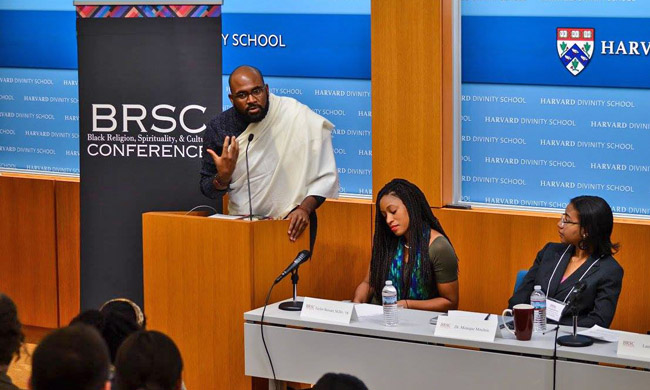
The inaugural Black Religion, Spirituality, and Culture conference, organized by Harambee, tackled the same questions of inclusion and representation in a community dedicated to justice, both at Harvard and in the wider world. MDiv candidate and conference organizer Taylor Stewart wrote that the “current dearth of black scholarship present within HDS” is a central anxiety that pervades the discourse around race, justice, and religion at the School.
These are difficult things to admit and even more challenging to remedy, yet this internal critique is central to our continued conversation about race and justice in the religious world and how the HDS community envisions itself for the future.
Future
Looking forward after two centuries, the HDS community is now bracing itself for a new and tenuous era for justice movements around the world. The HDS Racial Justice and Healing Initiative recently hosted a post-election community resource and skill-set mapping event to begin to tackle the variety of theological, moral, and practical concerns around social justice.
While these social justice movements continue to face the daunting forces of injustice in the world and here at home, Harvey Cox offers a moment of reprieve from great theological and moral leader Rev. Martin Luther King, Jr.
“I think Divinity students sometime get criticized for being unrealistic. It’s never been a criticism to me,” Cox explained. “I remember Dr. King used to say, ‘Who is unrealistic here? We are because we think we can end segregation in the South, or the people who think they can continue it?’ ”
It isn’t clear what will happen in the larger global context, but we can be positive that the HDS community remains at the forefront of these movements in Cambridge and beyond.
—by Kausik Mishra, MTS candidate